Will AI Replace Teachers? A Look at the Future of Education.
Will AI Replace Teachers? A Look at the Future of Education.
Reading Time: 8 mins
The Algorithm in the Classroom: Beyond Rote Memorization
The Algorithm in the Classroom: Beyond Rote Memorization
The promise of AI in education extends far beyond automating simple tasks. Think interactive simulations that adapt in real-time, not just to answers, but to a student's emotional state. Companies are already developing "affective computing" programs that analyze facial expressions and tone of voice, tailoring the learning experience to keep students engaged.
Imagine a history lesson where AI dynamically shifts its focus based on student interest. If a student lingers on a detail about Roman engineering, the system could instantly pull up related documents, videos, and even interactive 3D models. This moves education away from a one-size-fits-all model to a truly personalized journey. Market size estimates for AI in education suggest a multi-billion dollar industry within the next five years, reflecting the huge potential – and investment.
But the road isn't without its bumps. One major concern is algorithmic bias. If the AI is trained on data that reflects existing societal inequalities, it could perpetuate those biases in its teaching, inadvertently disadvantaging certain groups of students. Think about standardized test prep programs trained primarily on data from affluent schools.
Another friction point arises from the very nature of deep learning. AI algorithms often operate as "black boxes," making it difficult to understand why they made a particular decision. This lack of transparency could be problematic when assessing student performance or designing curricula. How do you challenge a result when the reasoning is opaque? Ensuring fairness and accountability will require careful design and constant monitoring.
The Tutor in Your Pocket: Personalized Learning's AI Revolution (and Its Pitfalls)
The Tutor in Your Pocket: Personalized Learning's AI Revolution (and Its Pitfalls)
Imagine a learning experience tailored to your exact needs. That's the promise of AI-powered personalized learning, a concept rapidly moving from sci-fi fantasy to tangible reality. Companies are developing sophisticated platforms that analyze student performance, identify knowledge gaps, and adapt the curriculum in real-time. Market size estimates suggest a multi-billion dollar industry within the next five years.
Think Duolingo, but for algebra, history, or even complex scientific concepts. These systems can present information in different formats, offer targeted practice exercises, and provide instant feedback, all designed to maximize individual student growth. The potential is enormous, particularly for students who struggle in traditional classroom settings.
However, the road to personalized learning isn't without its bumps. One major concern revolves around data privacy. These systems collect vast amounts of information about students. Questions about data security and how this information is used are definitely valid. Who has access? How is it protected? These answers are critical.
Another challenge is the "black box" problem. Many AI algorithms are opaque, making it difficult to understand why a particular recommendation was made. This lack of transparency can erode trust and hinder effective learning. If a student doesn’t understand why they’re struggling, the AI might be solving the symptom, not the root cause.
Furthermore, over-reliance on personalized learning could inadvertently create echo chambers. Students might only be exposed to information that confirms their existing beliefs. This could hinder critical thinking and limit exposure to diverse perspectives. The goal should be to augment, not replace, human interaction and broader learning experiences. Finding the right balance is essential.
Grading the Graders: Can AI Objectively Assess Subjectivity?
Grading the Graders: Can AI Objectively Assess Subjectivity?
Grading essays. Providing feedback on creative projects. These are tasks traditionally considered the domain of human educators, requiring nuanced judgment and an understanding of subjective expression. But can AI algorithms genuinely assess creativity, critical thinking, and the subtle art of communication?
The promise is compelling. AI-powered grading systems offer the potential for faster turnaround times and reduced teacher workload. Market size estimates suggest the automated grading market could reach billions within the next decade, fueled by institutions seeking efficiency gains. Tools already exist that can analyze grammar, syntax, and even assess the coherence of arguments with surprising accuracy.
Yet, the devil is in the details. Can an algorithm truly appreciate the unique voice in a student’s writing? Can it discern the originality of an artistic interpretation beyond pre-programmed parameters? Many worry about the inherent limitations of AI when evaluating subjective qualities.
One major concern is bias. AI models are trained on data, and if that data reflects existing societal biases, the algorithms will perpetuate them. A system trained primarily on essays from privileged backgrounds, for example, might unfairly penalize students with different writing styles or cultural references. This can lead to inequitable outcomes and further disadvantage already marginalized groups.
Another challenge is the "teach to the test" phenomenon, amplified by AI grading. If students know the specific criteria an algorithm uses to evaluate their work, they may focus on fulfilling those criteria, potentially stifling creativity and independent thought. We risk graduating a generation skilled at algorithm manipulation rather than genuine intellectual exploration. The line between objective assessment and stifling creativity is proving to be thinner than many anticipated.
The Human Touch: Why Empathy and Mentorship Still Matter
The Human Touch: Why Empathy and Mentorship Still Matter
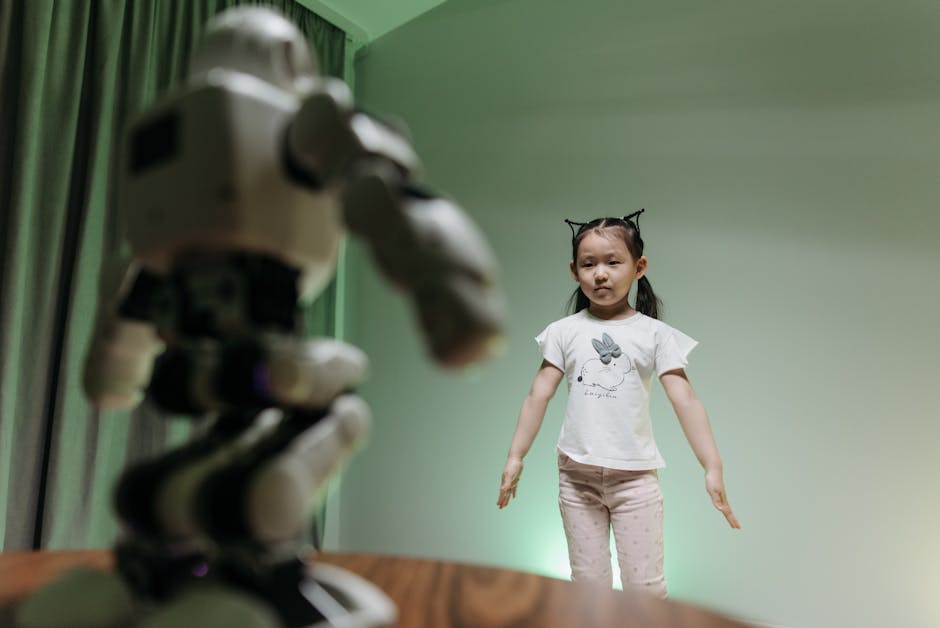
The robots may be coming for our jobs, but are they coming for our hearts? AI can personalize math problems with ruthless efficiency, identify learning gaps with laser precision, and free up teachers from administrative drudgery. But education is more than just data points and optimized algorithms. It's about connection.
Empathy, that elusive human quality, is the bedrock of effective teaching. A student struggling with algebra might not need another practice problem; they might need someone to listen, to understand the anxieties bubbling beneath the surface. Can an AI tutor offer that? Doubtful.
Mentorship is another irreplaceable element. Think about the teacher who saw potential you didn't know you had, who pushed you to explore new fields, who provided a safe space to fail and learn. Those moments of human connection shape lives. Market size estimates suggest the AI in education market will reach billions in the coming years, but can you really put a price on inspiration?
Consider the ethical dimensions too. AI, trained on existing data, risks perpetuating biases. A human teacher can actively combat these biases, creating a more equitable and inclusive learning environment. This requires critical thinking, nuanced understanding, and a commitment to social justice – qualities that are, for now, uniquely human.
The current enthusiasm for AI in education sometimes glosses over the fundamental need for human interaction. While technology can enhance learning, it cannot replace the critical role teachers play in fostering emotional intelligence, nurturing creativity, and guiding students toward becoming well-rounded individuals. The true future of education likely lies not in replacing teachers with AI, but in empowering them with it.
From Coding to Consciousness: Preparing Students for an AI-First World
From Coding to Consciousness: Preparing Students for an AI-First World
The future isn't about competing with AI; it's about collaborating. Today's students need skills that complement artificial intelligence, not replicate its capabilities. This requires a fundamental shift in curriculum and pedagogy.
Forget rote memorization of facts easily searchable by any chatbot. Instead, schools must prioritize critical thinking, complex problem-solving, and, perhaps most crucially, ethical reasoning. The World Economic Forum estimates that analytical thinking and innovation will be in even higher demand by 2025. Our education system must reflect that reality.
But how? Some schools are already experimenting with project-based learning, challenging students to tackle real-world problems using a combination of AI tools and human ingenuity. Imagine students using AI-powered design software to create sustainable housing solutions, then debating the ethical implications of their designs. It's active, engaging, and relevant.
The demand for AI ethics education is rising sharply. Market size estimates suggest a multi-billion dollar industry by the end of the decade. It's a reflection of growing societal unease about bias in algorithms and the potential for misuse of AI technology.
However, friction remains. Many teachers feel unprepared to integrate AI tools effectively. They need training, support, and access to resources. A rushed implementation without proper preparation risks creating more confusion than clarity. The focus should not be on simply adding AI to the classroom but on thoughtfully integrating it into a holistic learning experience that cultivates uniquely human skills alongside technological proficiency.
Beyond the Hype: A Realistic Roadmap for AI-Augmented Education
Beyond the Hype: A Realistic Roadmap for AI-Augmented Education
The breathless pronouncements about AI replacing teachers are, frankly, premature. The future of education isn't about wholesale replacement, but strategic augmentation. A more plausible vision involves AI taking on repetitive tasks, freeing educators to focus on higher-level skills like critical thinking, creativity, and social-emotional learning.
Think of AI as a highly skilled teaching assistant. It can personalize homework assignments based on student performance, identify learning gaps in real-time, and provide instant feedback. Market size estimates suggest the AI in education market will reach billions in the coming years, highlighting the investment and anticipated growth in this area.
However, smooth integration isn't guaranteed. One major hurdle is data privacy. Student data is incredibly sensitive, and robust safeguards are crucial to prevent misuse or breaches. Another friction point will be teacher training. Educators need to be equipped with the skills to effectively utilize AI tools and interpret the data they provide. Simply throwing technology into the classroom won't magically improve outcomes.
Consider the example of AI-powered grading systems. While potentially useful for objective assessments like multiple-choice quizzes, they struggle with subjective evaluations of essays or creative projects. This highlights the need for human oversight to ensure fairness and nuance. Furthermore, algorithmic bias is a real concern. If the AI is trained on biased data, it could perpetuate existing inequalities in the education system. A careful, ethical approach is paramount.
The real promise of AI in education lies in its potential to create more personalized and engaging learning experiences. But realizing that promise requires careful planning, thoughtful implementation, and a steadfast commitment to prioritizing the needs of both students and teachers.
Frequently Asked Questions
Frequently Asked Questions
Okay, here are 5 FAQ Q&A pairs in Markdown format for the topic "Will AI Replace Teachers? A Look at the Future of Education," keeping the answers concise:
Q1: Will AI completely replace human teachers in the future?
A1: No, AI is unlikely to completely replace teachers. It's more likely to augment and support their roles.
Q2: What aspects of teaching can AI potentially handle?
A2: AI can assist with tasks like grading, personalized learning plans, data analysis, and providing immediate feedback.
Q3: What are the key benefits of using AI in education?
A3: Personalized learning, increased efficiency, and access to education for remote or underserved areas.
Q4: What are the limitations of AI in education?
A4: AI lacks emotional intelligence, critical thinking in complex situations, and the ability to build strong student-teacher relationships.
Q5: How should educators prepare for the increasing role of AI in education?
A5: By focusing on developing skills AI can't replicate, such as creativity, empathy, and complex problem-solving.
Disclaimer: The information provided in this article is for educational and informational purposes only and should not be construed as professional financial, medical, or legal advice. Opinions expressed here are those of the editorial team and may not reflect the most current developments. Always consult with a qualified professional before making decisions based on this content.